
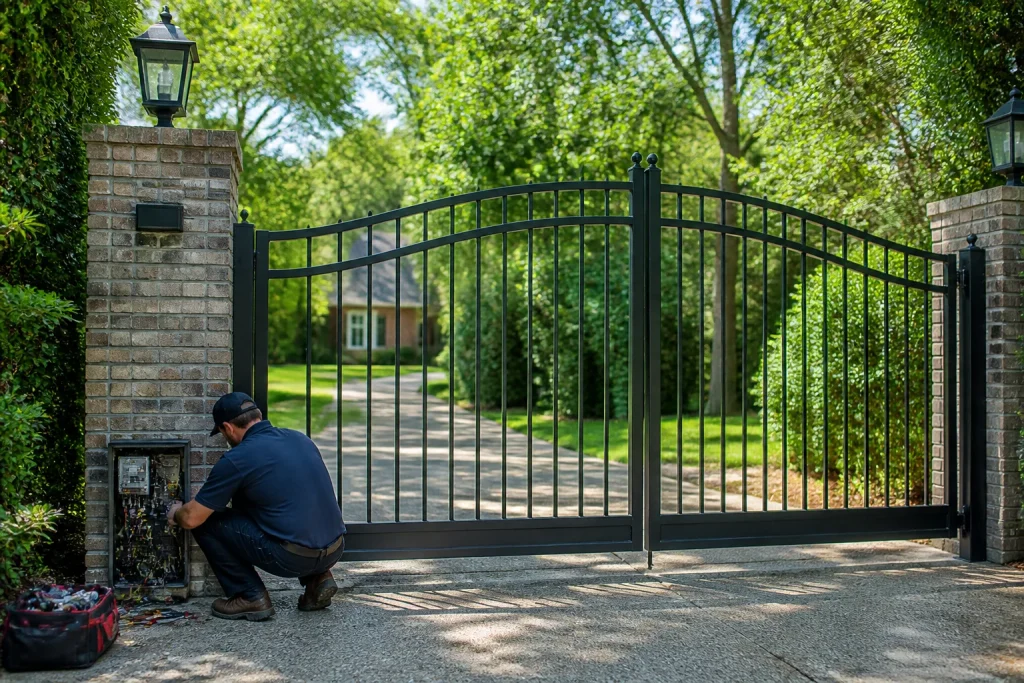
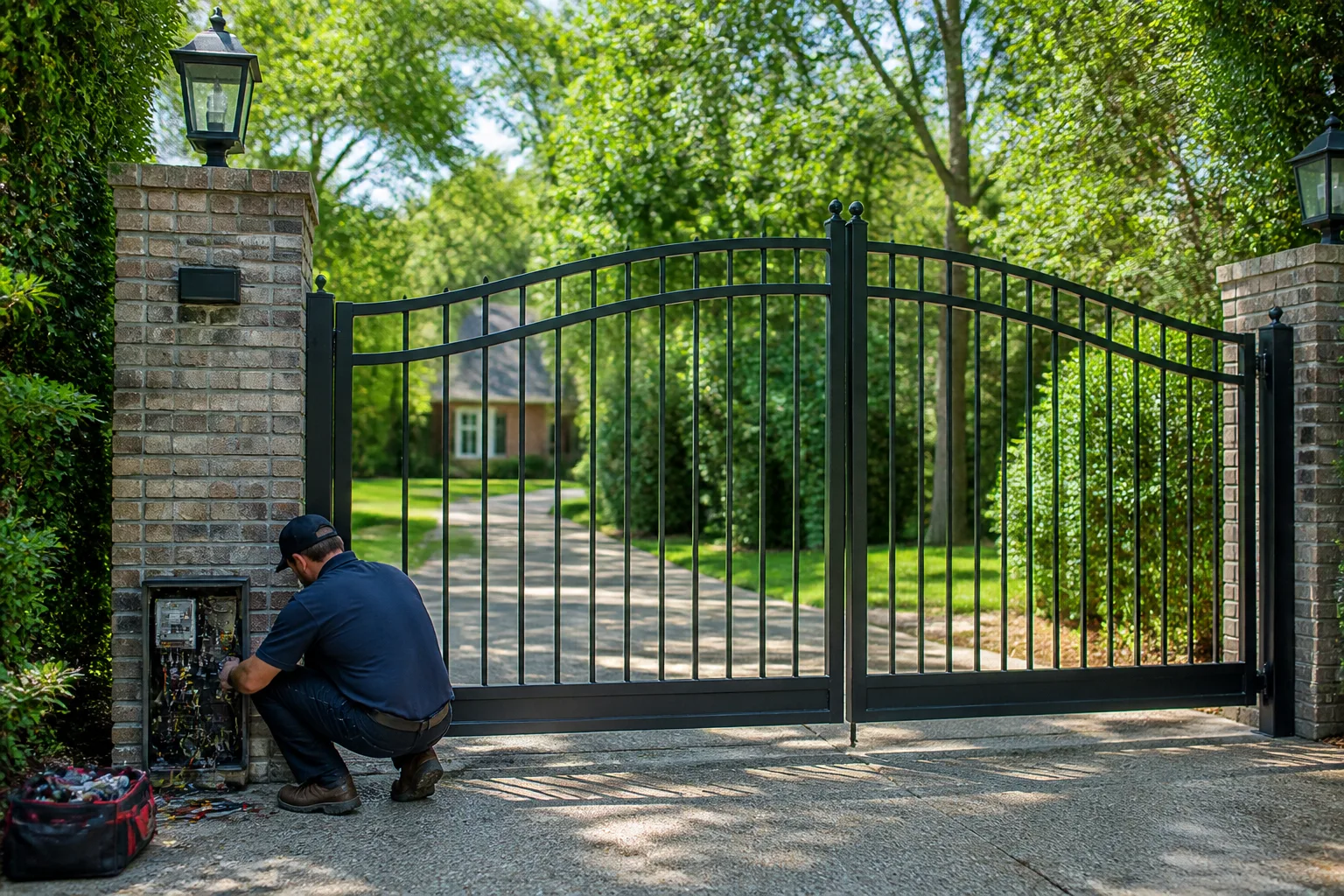
DoorKing Gate Repair in Richmond: A Homeowner’s Guide
If your DoorKing gate has started acting up, the motor is probably the last thing that’s wrong with it. DoorKing operators are built to commercial-grade standards, and in our experience they routinely outlast two or three competitor units before anything major fails. The expensive mistake we see over and over isn’t a dead drive unit. It’s a technician who assumes the motor is dead and sells you a replacement when the real fault is a corroded intercom connection or a grounded loop detector. This guide is about diagnosing the actual problem first.
DoorKing systems across Richmond are a different animal from a basic residential swing operator. They’re access control systems first and gate motors second, and they fail in ways that generalist technicians misread. We work on DoorKing systems regularly, and we’ve learned where these units actually break. If you’d rather not climb that diagnostic ladder yourself, call (866) 942-6565 and we’ll point you in the right direction.
Key Takeaways
- DoorKing drive units are durable. Access control boards, loop detectors and intercom wiring are what fail.
- The 1800-series slide operators, 9100-series telephone entry systems and swing gate models each fail differently and need different diagnostics.
- Humidity and ground faults are the two biggest DoorKing troublemakers in Richmond’s climate.
- Some DoorKing parts and firmware require dealer network access. Ask a repair company how they source parts before you book.
- Error codes narrow the diagnosis fast. Knowing what each one means keeps you from paying for a motor you didn’t need.
What Are the DoorKing Product Lines, and Why Does Each Need a Different Repair Approach?
DoorKing builds three broad categories of equipment, and a repair that works on one won’t necessarily apply to another. The 1800-series slide gate operators move the gate itself, the 9100-series telephone entry systems handle visitor access and communication, and the swing gate operators cover driveway and pedestrian swing applications. Homeowners often use “DoorKing” as shorthand for all of it, but these are separate systems with separate failure points.
The 1800-series slide operator is a heavy-duty unit with a chain or rack drive, limit switches and its own control board. When it stops responding, the fault usually lives in the board, the limit settings, or the safety loop circuit rather than the gearbox. The 9100-series telephone entry system is a completely different repair: it’s a communications device with a keypad, a display, a directory and connections to the intercom and gate release. Corroded terminals and dead backup batteries cause most of its problems. Swing operators sit in between: mechanical arms or articulated arms, control boards, and their own set of safety edges and reverse sensors.
That’s why a call that starts with “my DoorKing gate won’t open” needs to be narrowed to “my DoorKing 1800-series slide operator won’t open” before anyone can diagnose it. The repair approach, the parts and the likely cost are all different. When we take a DoorKing call in Richmond, the first thing we do is confirm which family of equipment we’re dealing with and which board or controller is actually in play.
What Are the Most Common DoorKing Failure Points in Richmond’s Climate?
Humidity and ground faults account for a large share of DoorKing failures in Richmond. Virginia’s summer humidity pushes moisture into outdoor intercom and control enclosures, and the corrosion that builds on the 9100-series intercom board connections causes intermittent keypad failures, garbled calls and dead gate releases. The other big one is a loop detector ground fault, which produces the classic “ghost cycling” behavior where a gate opens or closes with no vehicle in sight.
Richmond’s soil and moisture patterns matter here too. Ground loop wiring buried under a driveway is vulnerable to nicks, water intrusion and shifting soil, and any of those can send a false vehicle-detection signal to the operator. When a gate cycles randomly, most generalists reset the control board and call it fixed. The real cause is usually a damaged loop or a grounding issue, and it will come back.
The other failures we see on DoorKing equipment in Richmond include:
- Corroded intercom terminals on the 9100-series board after a humid summer, causing no-call or no-release faults.
- Control board moisture damage inside the operator enclosure when the gasket or seal has aged out.
- Loop detector ground faults sending false detect signals and triggering random cycling.
- Limit switch drift on 1800-series slide operators, so the gate won’t fully open or close.
- Backup battery failure in telephone entry units, wiping the directory and timekeeping.
- Safety edge and reverse sensor faults that stop the gate mid-travel.
If a gate has failed, don’t keep cycling it to “test” it. Heavy gate panels can crush, and a gate that reverses incorrectly is a real hazard. A trained technician should be the one to diagnose a safety-related fault. That’s not a DIY call.
Do I Need a DoorKing Dealer-Network Technician, and How Do I Verify One?
DoorKing parts, firmware and diagnostic software aren’t always available to the open market, and that’s the single biggest reason DoorKing repairs go sideways. A technician without dealer network access can swap a motor, but they can’t always source the correct control board or flash the correct firmware. That leaves your gate partially repaired, or running on a workaround that fails again next season.
Before you book a DoorKing repair in Richmond, ask three specific questions:
- “Do you work on DoorKing systems specifically, and which models?” A technician who names the 1800-series, 9100-series or swing operators knows the equipment. A vague answer means you may get a generalist who’s googling it in your driveway.
- “How do you source DoorKing parts and firmware?” You’re looking for a clear answer about authorized sourcing, not a shrug. If they can’t tell you how a board gets ordered, they probably can’t get one.
- “Will you diagnose the board and loop before replacing the motor?” A good answer confirms a diagnostic-first approach. A bad one jumps straight to replacement.
DoorKing is one of the brands we work on regularly. That familiarity means we don’t spend your first visit learning the layout of a 9100 board or hunting for the limit switch on an 1800-series operator. It’s the difference between a repair and a parts-swapping experiment. That said, we’re an independent gate specialist, not a factory-authorized DoorKing dealer, and we won’t claim otherwise. What we will tell you is where we can source parts and what the honest options are for your system.
What Do DoorKing Error Codes Actually Mean?
DoorKing fault indicators are diagnostic shorthand, not a final verdict. The codes narrow the problem to a circuit or subsystem, and from there a technician traces it to the actual component. Knowing roughly what each code points to helps you gut-check what a repair company tells you. Here’s a plain-language rundown of the most common fault types:
- Gate reversing or stopping mid-cycle without an obstruction: usually a safety edge, reverse sensor or loop detect issue. Rarely the motor. Check whether the loop detector is the culprit before anything is replaced.
- Gate not responding to a keypad or remote: typically an access control or intercom board fault, or a bad connection at the board. Often addressed by cleaning and reseating terminals on the 9100-series board.
- Random cycling with no input: almost always a false detect signal from a damaged or damp loop, or a grounding issue. This is the code that gets misdiagnosed as a board failure most often.
- Limit or travel faults: a limit switch out of adjustment or a mechanical obstruction on a 1800-series slide operator. Many of these are correctable without new parts once the switch is reset.
- Communication faults on a telephone entry system: a bad intercom line, a dead backup battery on the 9100 board, or corrosion at the terminals.
What you should not do is use an error code as a shopping list. A “board fault” indicator can mean a failed board, or it can mean a loose terminal that a five-minute reseat fixes. That’s the honest, board-level diagnostic difference. If you’re seeing repeated fault codes and don’t want to gamble on parts, call (866) 942-6565 and we’ll help you sort the real fault from the noise.
What Do DoorKing Repairs Cost in Richmond?
DoorKing repair costs in Richmond depend on which component is actually failing, not on the brand name. The honest answer is that a board-level diagnosis usually saves money, because most DoorKing problems are not motor replacements. A loop detector replacement or intercom board repair will cost a fraction of a new operator, and that’s the difference between fixing a DoorKing system and replacing it unnecessarily.
When you get a quote, ask the technician to explain which subsystem is failing and why. Here’s the rough order of magnitude for the common repair categories, keeping in mind that final pricing depends on your specific model and fault:
| Repair Type | What It Typically Involves | Cost Range |
|---|---|---|
| Intercom board repair/replacement | Cleaning, reseating or swapping the 9100-series access control board | Lower cost |
| Loop detector replacement | Replacing the detector or re-running the buried loop circuit | Moderate cost |
| Control board replacement | Swapping the operator control board after board-level diagnosis | Moderate to higher cost |
| Operator or motor replacement | Replacing the full drive unit (often unnecessary) | Highest cost |
We quote per job and we quote before we start, so you know what you’re approving. Prices depend on model, part sourcing and the diagnosis. The written estimate sets the final price, and a good DoorKing technician should always explain the diagnostic reasoning behind it. If the estimate is a motor replacement and nobody’s checked your loop detector or board connections, ask why. For broader help with a failed gate, see our gate repair service page, and for access control and operator faults specifically, our electric gate repair page covers more detail.
When Should You Call a Pro Instead of DIY?
Call a pro when the fault is electrical, safety-related, or board-level. DoorKing operators involve line voltage, access control circuitry and heavy moving gate panels. A misstep at the board or the power run isn’t a nuisance repair, it’s a genuine safety risk. A heavy slide or swing gate can crush, and a gate that reverses incorrectly is the most dangerous failure on the system.
You can cheaply and safely do the basics: confirm the power is on, look for obvious gate obstructions, and check whether the keypad or intercom shows any sign of life. Beyond that, leave the board, the wiring and the loop to a technician. DoorKing systems also need model-specific knowledge for firmware and parts, and that’s not a DIY-friendly piece of equipment. Recognizing the difference between a simple reset and a board-level repair is the real value a specialist brings.
The Bottom Line
DoorKing makes tough commercial-grade operators, and most of what goes wrong with one in Richmond isn’t the motor. It’s the intercom board, the loop detector, the control board or a bit of corrosion from our humid summers. The repair strategy depends on which DoorKing family you own, and the right answer is a board-level diagnosis before anything gets replaced. That’s the approach we take as a dedicated gate specialist, and as Richmond Gate Repair we handle DoorKing, Ghost Controls, Elite and other systems with that same brand-specific approach. If you’re in Richmond and need help, Richmond Gate Repair offers free estimates. Call (866) 942-6565. We answer 24/7. Fast dispatch from 7am to 7pm, Sunday through Friday.
Frequently Asked Questions
Most of it, no. You can safely check for power and obvious obstructions, but board-level, loop and wiring diagnostics involve live electrical components and heavy gates. A trained technician should handle anything past the basics.
Random cycling almost always points to a false signal from the loop detector or a grounding issue, not a failed motor. That’s the most commonly misdiagnosed DoorKing fault, and it deserves a proper loop and ground check before any part is replaced.
Not necessarily, but you do need a technician with genuine DoorKing experience and reliable parts sourcing. Ask directly how they source DoorKing boards and firmware and whether they work on your specific model before you book.
Usually not. A board-level fault is often fixable at the board, which is a fraction of the cost of a full operator. The honest repair path is to confirm the failing subsystem first, which is exactly why a diagnostic-first approach matters with DoorKing equipment.
Have your model number and the specific behavior handy: what it does, when it happens, and which DoorKing system it is (1800-series operator, 9100-series entry system or swing). That moves the diagnosis forward fast and saves your technician time. For a broader service overview, our Richmond page lists what we cover. Call (866) 942-6565 for a free estimate.
Written by the team at Richmond Gate Repair.
Need Gate Repair Help?
Call Richmond Gate Repair - licensed & insured, here with fast help in Richmond.
(866) 942-6565